
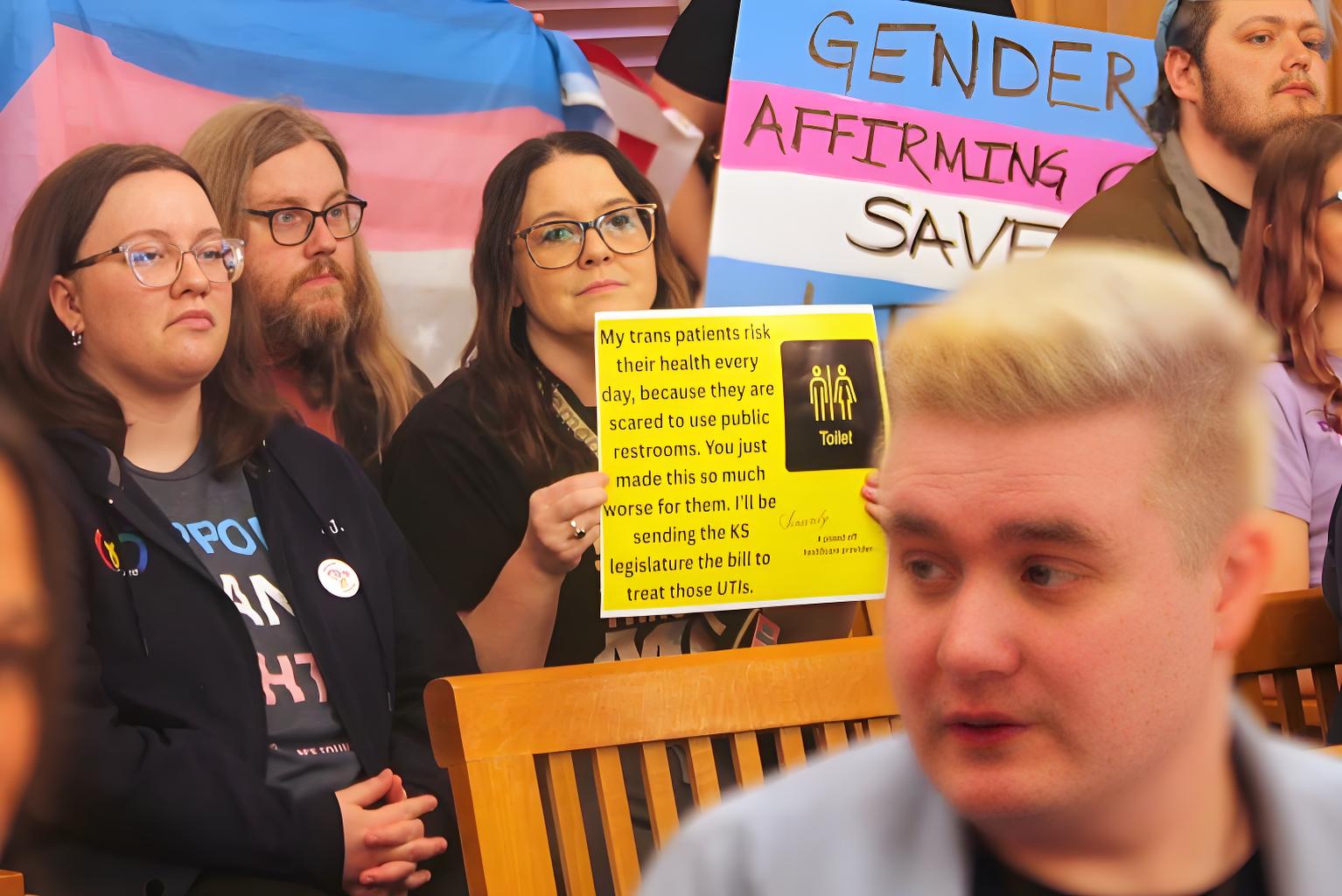
Amanda Mogoi, an advance practice registered nurse who provides care for transgender patients in Wichita, Kan., participates in a protest against a new Kansas law that prevents transgender people from changing their birth certificates and driver's licenses to reflect their gender identities and imposes new, tough enforcement provisions in state restrictions on their bathroom use with a sit-in during a legislative committee hearing, Friday, Feb. 6, 2026, at the Statehouse in Topeka, Kan.
Two transgender individuals have initiated legal action against a recently enacted law in Kansas that renders their driver's licenses invalid if they do not correspond to their sex assigned at birth. The legislation, which became effective on a specified date, permits those affected to exchange their current licenses for ones that align with their birth sex.
The measure was initially rejected by state authorities but was subsequently approved through legislative override. Representatives from the American Civil Liberties Union of Kansas described the law as an infringement on the fundamental rights and personal integrity of transgender people, emphasizing its conflict with state protections against excessive governmental intervention.
The plaintiffs, referred to under pseudonyms as Daniel Doe and Matthew Moe, seek a judicial ruling to deem the law unconstitutional and halt its implementation. According to the complaint, the statute deprives transgender residents of the right to drive or use identification without prior notification or a fair hearing process.
Beyond driver's licenses, the law extends to birth certificates, declaring any that do not match birth sex as void. It also mandates that public facilities in government buildings, such as restrooms and changing areas, be restricted based on birth sex, with significant fines imposed on agencies failing to comply.
Additionally, the legislation empowers individuals who feel impacted by the presence of someone of the opposite sex in these spaces to pursue legal claims for compensation amounting to $1,000.
Official estimates indicate that approximately 1,700 licenses may be revoked and 1,800 birth certificates reissued as a result.
The lawsuit contends that the law breaches state constitutional assurances of individual autonomy, privacy, equal treatment, procedural fairness, and freedom of expression. It highlights immediate adverse effects on transgender individuals, including barriers to using public restrooms aligned with their gender identity.
The filing warns that continuing to use familiar restrooms could lead to legal penalties, including fines or misdemeanor charges, and potential lawsuits from others. Conversely, switching to facilities matching birth sex might expose individuals to outing, harassment, or violence, while still risking legal action.
In an official veto statement, state leadership criticized the bill for its unclear drafting and potential unintended impacts, such as restrictions on family visits in shared living arrangements like dormitories or care facilities. Authorities urged a focus on improving economic conditions rather than regulating personal matters.
This development occurs amid broader efforts in various states to enact measures affecting transgender individuals. Advocacy groups report over 70 laws targeting the LGBTQ community were adopted nationwide in the previous year, often involving restrictions on sports participation or facility access based on gender identity.
At the federal level, the national government has advanced policies limiting transgender rights, including curbs on athletic involvement and medical care for youth. Recent court decisions have upheld federal restrictions on passport gender markers and military service for transgender personnel.
North American Editorial Office: Robin