
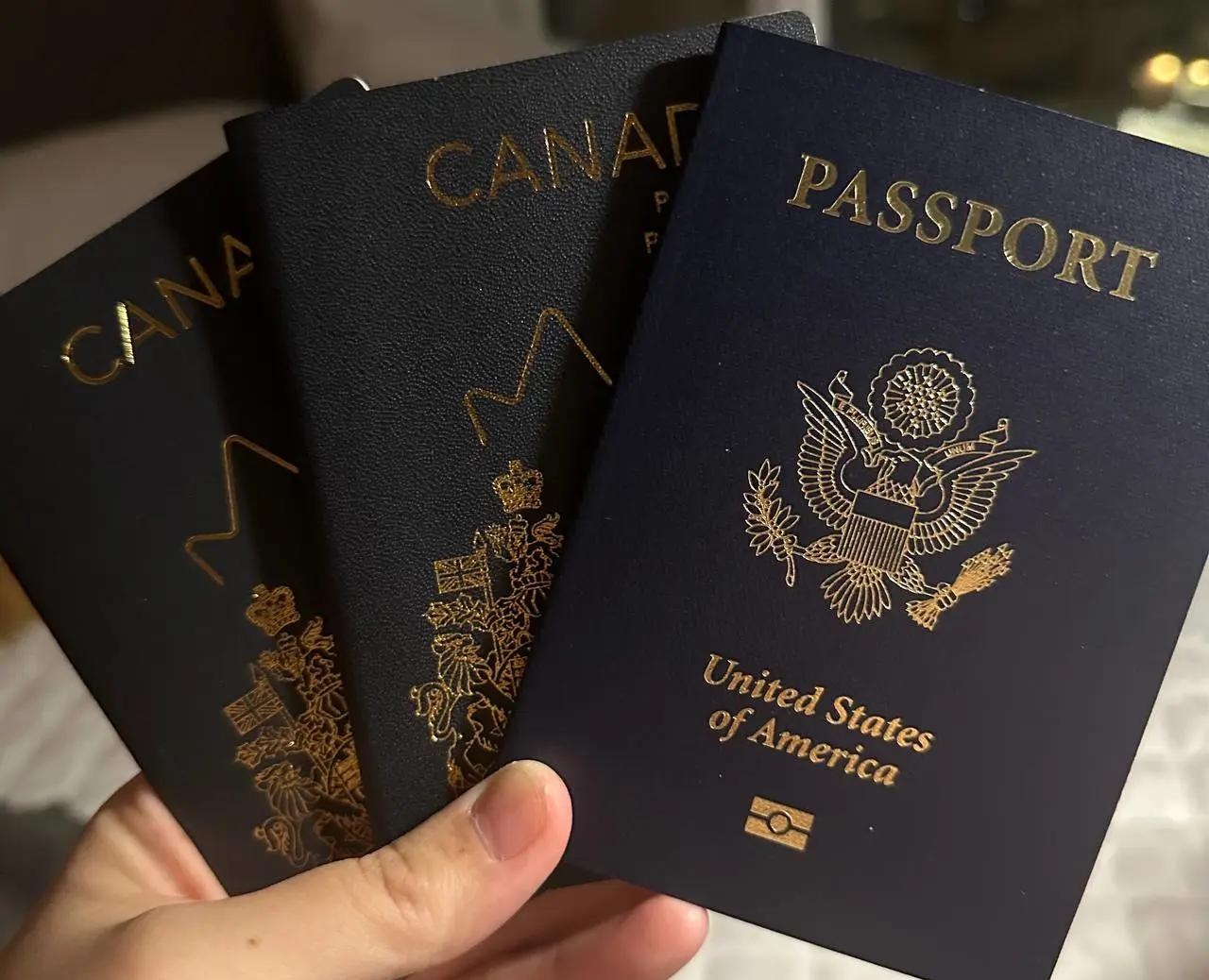
US passport
Washington—The nation's Supreme Court on Thursday allowed the current administration to enforce a policy aimed at limiting gender designations on passports. Under this new policy, sex designations will be restricted to "male" or "female" based on the sex assigned at birth.
The action came after the justices granted an emergency request filed by the administration. The government is seeking to reverse a policy introduced during the previous administration that allowed people to put "X" as a gender marker or self-select male or female, and which had removed the need for medical proof of gender transition.
In an unsigned order, the court stated: "Displaying passport holders’ sex at birth no more offends equal protection principles than displaying their country of birth—in both cases, the Government is merely attesting to a historical fact without subjecting anyone to differential treatment".
The three liberal justices on the conservative-majority court dissented. "The Government seeks to enforce a questionably legal new policy immediately, but it offers no evidence that it will suffer any harm if it is temporarily enjoined from doing so, while the plaintiffs will be subject to imminent, concrete injury if the policy goes into effect," Justice Ketanji Brown Jackson wrote in a dissenting opinion.
The new policy effectively means that transgender people, even those who have fully transitioned and have medical records, may not be able to obtain gender markers on their passports that correspond with their identities.
On the administration's side, Solicitor General D. John Sauer argued in court papers that the new policy is "eminently lawful". "The Constitution does not prohibit the government from defining sex in terms of an individual’s biological classification," he contended.
Conversely, Jon Davidson, a lawyer at the American Civil Liberties Union representing transgender people challenging the policy, called the decision "a heartbreaking setback for the freedom of all people to be themselves, and fuel on the fire the... administration is stoking against transgender people and their constitutional rights".
The policy was challenged by several transgender individuals, who alleged it violated their right to equal protection under the Constitution's Fifth Amendment, as well as the Administrative Procedure Act. "This new policy puts transgender, nonbinary, and intersex people in potential danger whenever they use a passport," the plaintiffs' lawyers wrote in court papers.
The lawyers also noted that the State Department has, in certain circumstances since 1992, allowed people to choose a male or female marker not corresponding to their birth gender. They argue the new policy reverses a 30-year trend of giving applicants choice.
The named plaintiff in the case is Ashton Orr, a transgender man from West Virginia. He applied for a passport with a male sex marker in January and was told by the State Department in February that he could only have a female marker.
Previously, a federal judge in Massachusetts had ruled against the administration, and the Boston-based 1st U.S. Circuit Court of Appeals declined to put that ruling on hold.
The current administration has regularly escalated its policy disputes to the Supreme Court when blocked by lower courts. While this ruling is not final and litigation will continue, it signals how the case may ultimately be decided.
North American Editorial Office: Robin