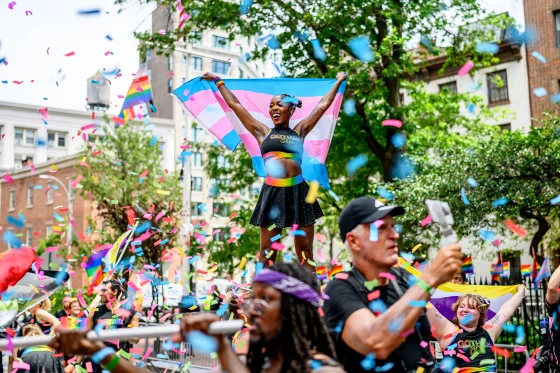
New York City Pride March on Sunday.
The monthlong LGBTQ Pride celebrations reached a vibrant climax on Sunday, as massive crowds gathered for daylong street festivities from New York to San Francisco, with rainbow flags waving throughout.
Pride events have long blended political expression and protest with colorful pageantry, but this year’s iterations took on a more defiant tone amid efforts to roll back
LGBTQ-friendly policies.
Manhattan’s celebration adopted the theme “Rise Up: Pride in Protest,” fitting the current climate; San Francisco’s theme was “
Queer Joy is Resistance,” while Seattle’s was simply “Louder.”
Lance Brammer, a 56-year-old teacher from Ohio attending his first New York Pride parade, wore a bright, multicolored shirt and expressed feeling “validated” by the scale of the nation’s oldest and largest such event. “Given the current political climate, it feels like they’re trying to erase the entire
LGBTQ community, especially the trans community,” he said. “But with all these people here and all this support, they’ve got a fight ahead if they think they can pull that off.”
In San Francisco, Xander Briere, a program specialist at the San Francisco Community Health Center, noted that the
LGBTQ+ community is fighting for survival amid sustained attacks and shifting public sentiment, particularly toward
transgender people. “We’re slowly moving backward, and it’s unfortunate and scary,” he said. “It feels like the world is against us right now, but this beautiful community celebration is an act of resistance, a testament to our history, showing the world we’re here and we’re not going anywhere.”
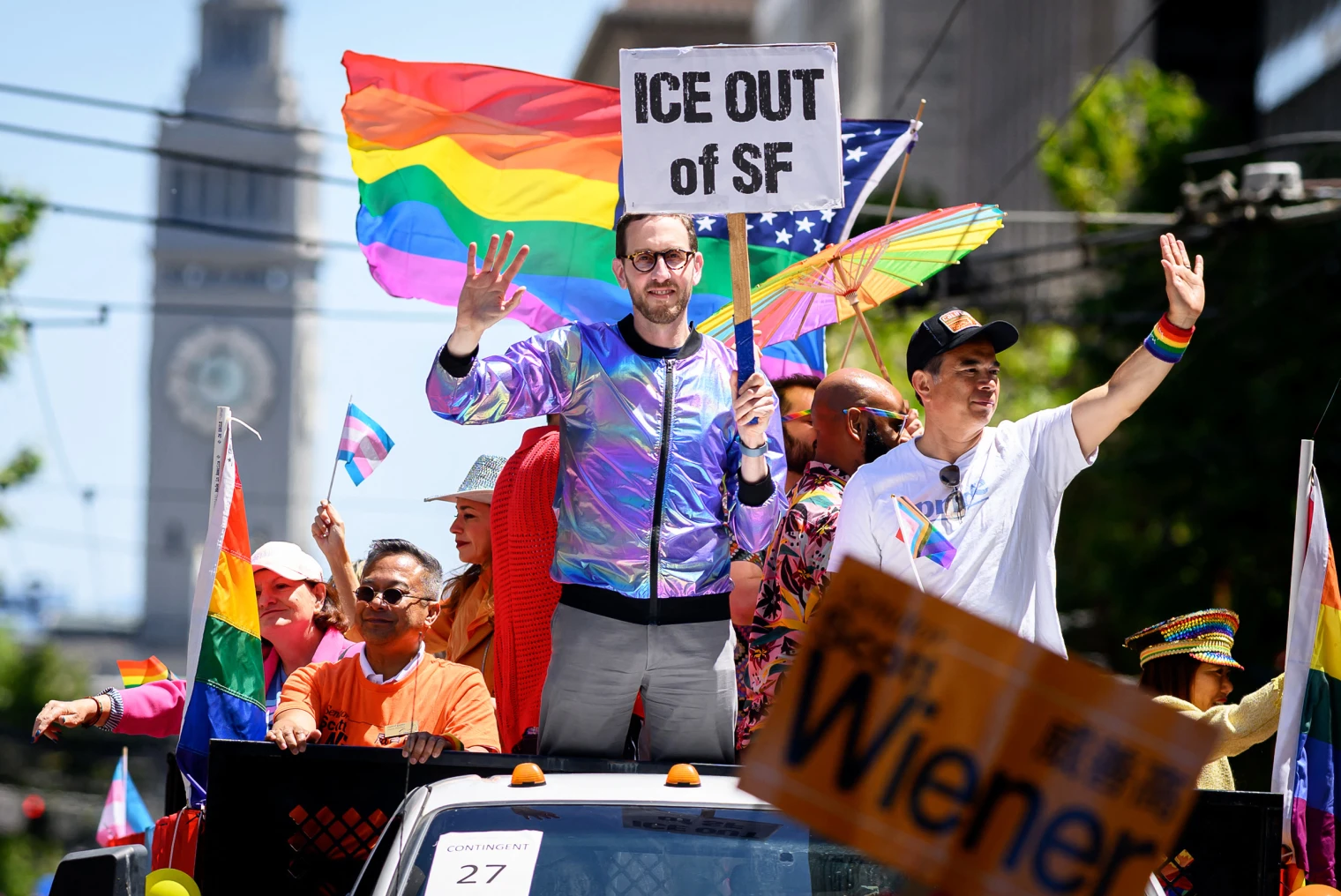
California State Senator Scott Wiener, center, at the San Francisco Pride Parade on Sunday.
Manhattan’s parade proceeded down Fifth Avenue, with over 700 participating groups greeted by large crowds. The procession passed the Stonewall Inn, a Greenwich Village gay bar where a 1969 police raid sparked protests and galvanized the LGBTQ+ rights movement. The first Pride march, held in New York in 1970, marked the one-year anniversary of the Stonewall uprising, and the site is now a national monument.
Meanwhile, in San Francisco—host to one of the world’s largest Pride events—marchers proceeded down Market Street to concert stages at Civic Center Plaza. Other major North American cities including Denver, Chicago, Seattle, Minneapolis, and Toronto, Canada, also held Pride parades on Sunday.
Events in global cities vary in timing: Tokyo, Paris, and São Paulo held theirs earlier this month, while others like London (July) and Rio de Janeiro (November) will take place later in the year.
This year,
transgender people have been targeted by specific policies, including restrictions on military service, bans on federal insurance covering gender-affirming surgeries for youth, and attempts to bar
transgender athletes from girls’ and women’s sports.
“We have to be visible. We have to come together. We have to fight. They’re trying to erase our existence,” said Jahnel Butler, one of the community grand marshals at San Francisco’s parade.
Peter McLaughlin, a 34-year-old Brooklyn resident who has lived in New York for years but never attended a Pride parade, felt compelled to participate this year as a
transgender man. “A lot of people just don’t understand that letting others live their lives doesn’t take away from their own experience. Right now, it’s important to show we’re just people,” he said.
Gabrielle Meighan, 23, from New Jersey, noted the significance of this year’s celebrations, coming days after the 10th anniversary of the Supreme Court’s landmark June 26, 2015, ruling in Obergefell v. Hodges, which legalized
same-sex marriage nationwide.
Manhattan also hosted the
Queer Liberation March on Sunday, an activism-focused event launched in recent years amid concerns that the more mainstream parade had become overly corporate. Marchers carrying signs like “Gender-affirming care saves lives” and “No Pride in apartheid” walked north from the city’s AIDS Memorial to Columbus Circle near Central Park.
Another challenge facing
gay rights groups this year is the loss of corporate sponsorships. American companies have scaled back support for Pride events, reflecting a broader retreat from diversity and inclusion efforts amid shifting public sentiment.
NYC Pride stated earlier this month that about 20% of its corporate sponsors had reduced or withdrawn support, including PepsiCo and Nissan. Organizers of San Francisco Pride said they lost support from five major corporate donors, including Comcast and Anheuser-Busch.
North American Editorial Office: Robin
