
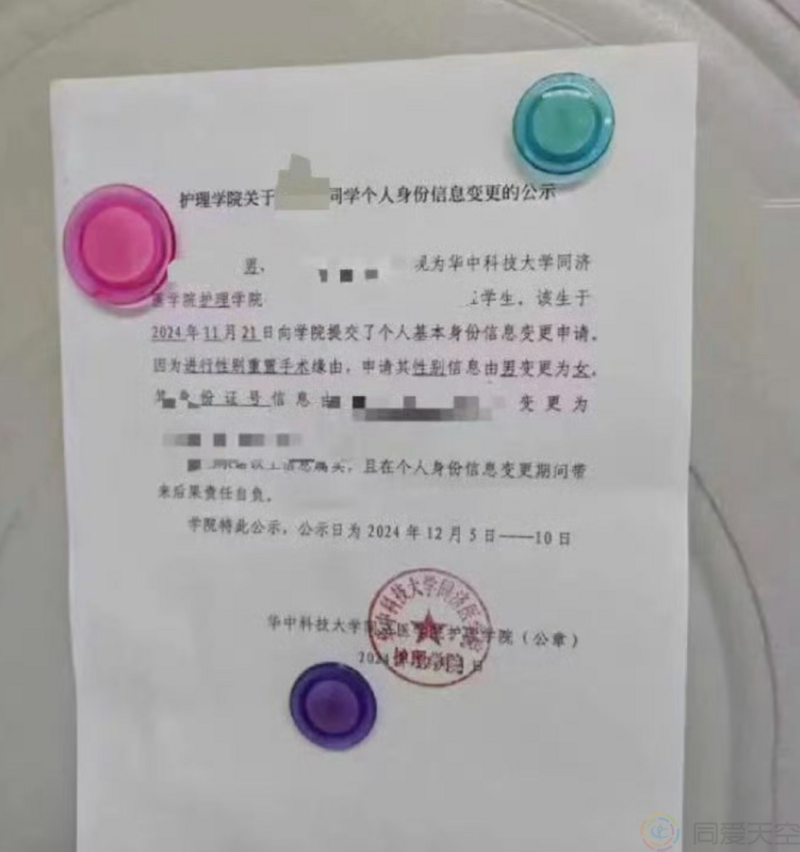
Recently, the Nursing School of Tongji Medical College at Huazhong University of Science and Technology has drawn public attention due to its public notice of a student's gender change application. The notice detailed the applicant's name, major and class, ID number, and other information, aiming to complete the identity information change process. The school authorities responded that this action was in line with internal procedures. However, legal professionals pointed out that the excessive disclosure of sensitive information might constitute a privacy violation.
The incident originated from a male student's application to change his gender information after undergoing gender - reassignment surgery. The content of the public notice showed that the applicant needed to pass a 15 - day public notice period to confirm the effectiveness of the change. The person in charge of the Nursing School's office confirmed the authenticity of the public notice but did not explain the specific regulations it was based on. In response, Xiong Bingqi, the president of the 21st Century Education Research Institute, said that the original intention of the public notice might be to reduce misunderstandings in daily life scenarios, but a comprehensive disclosure to the public was unnecessary.

The focus of the controversy centered on the reasonable scale of information disclosure. Fu Jian, the director of Henan Zejin Law Firm, pointed out that ID numbers and the reasons for surgery were sensitive information clearly protected by the Personal Information Protection Law. Publicly disclosing such information might increase the risk of information abuse. Some netizens supported the public notice, believing that it was a necessary measure to protect the right to know of other students, especially when it came to practical issues such as dormitory allocation and the use of public facilities.
It is worth noting that China's current laws and regulations do not mandate universities to publicly disclose gender change information. The Measures for the Electronic Registration of Students' Academic Records in Institutions of Higher Learning issued by the Ministry of Education only require internal filing of information changes and do not require public disclosure. Experts suggested that schools could balance procedural transparency and privacy protection by sending targeted notifications to relevant departments or using anonymization methods.
At present, the student involved has not made a public statement, and the school authorities have not responded to the adjustment of the content of the public notice. This incident reflects the dilemma that universities face in handling the rights and interests of minority groups. How to balance institutional norms and individual dignity remains an urgent social issue to be resolved.
Editor: Newsroom - Robin