
Regional Progress and Current Public Attitudes
Taiwan has consolidated its regional leadership position on LGBTQ+ rights through legal framework reforms since legalising same-sex marriage in May 2019.
According to polling data released by the Taiwan Equality Campaign, support for same-sex marriage in 2026 remains unchanged at 54.3% from the previous year. However, surveyed categories including adoption rights, transnational same-sex marriage, and gender equality education demonstrated substantial increases in public support.
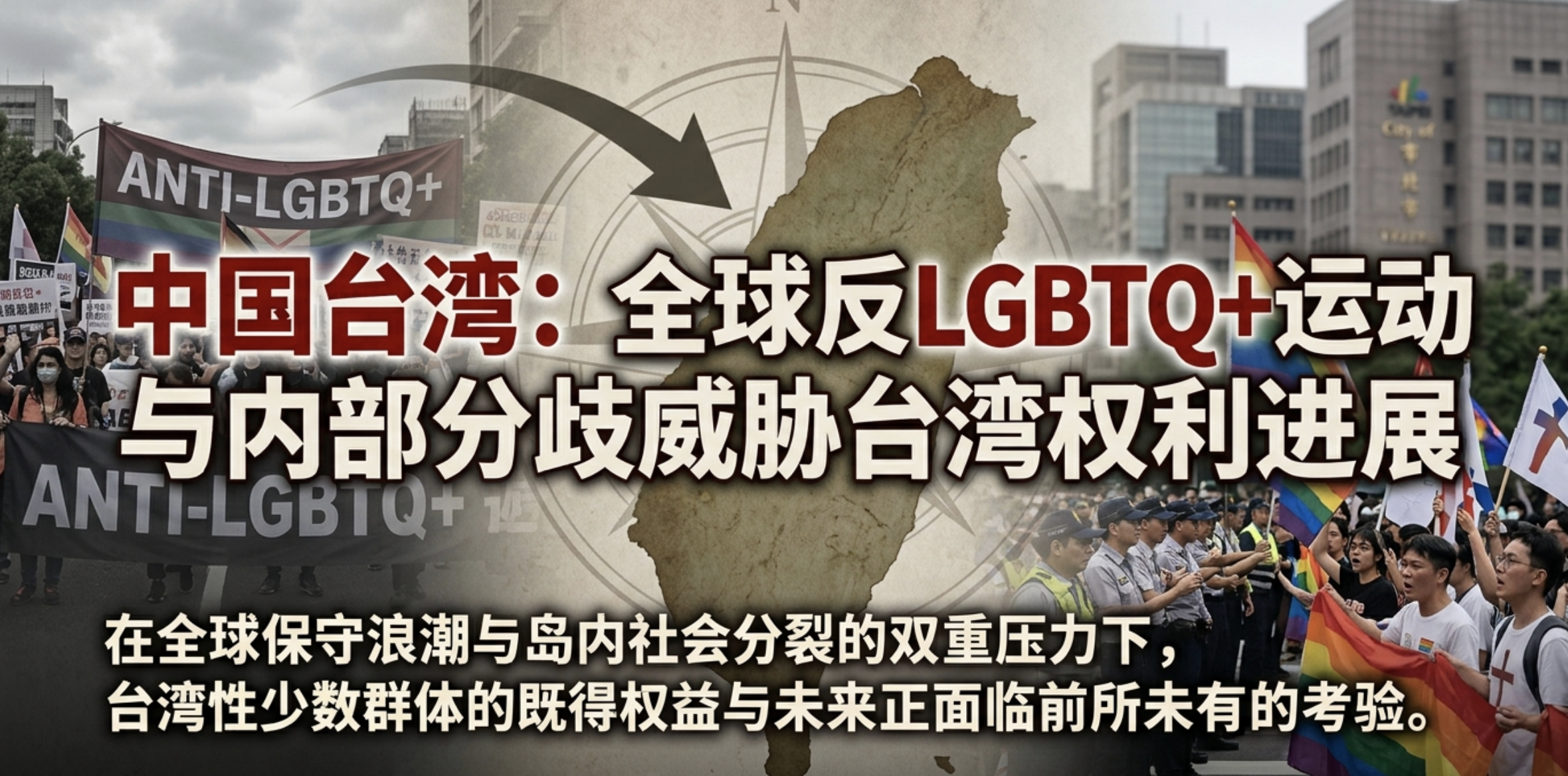
Despite achieving measurable progress, Taiwan's LGBTQ+ movement faces substantial headwinds including mounting global hostility toward LGBTQ+ communities, domestic political repression targeting sexual minorities, and internal divisions within Taiwan's LGBTQ+ community itself. These challenges threaten to derail LGBTQ+ rights advancement and undermine the nation's democratically-achieved values.
Global Anti-LGBTQ+ Movement Ascendancy
Globally, far-right mobilisations have strengthened resistance to LGBTQ+ movements. Under the banner of combating "gender ideology," right-wing populist leaders, conservative parties, illiberal and authoritarian regimes, and religious movements attempt to rescind existing legal protections for same-sex marriage and LGBTQ+ rights, eliminate critical education regarding gender and sexuality, and weaken civil society organisations advocating for LGBTQ+ human rights.
State and non-state actors focused on defending traditional "family values" have formed transnational coalitions designed to reshape international gender norms through altering equal rights policy language and establishing multilateral forums advancing their ideological interests.
Meanwhile, global support for LGBTQ+ rights has declined marginally. Ipsos' 2025 LGBTQ+ Pride Report covering 26 countries demonstrated reduced support for multiple LGBTQ+ rights issues. Support for same-sex marriage declined from 74% in 2021 to 69% in 2025, whilst support for same-sex couples receiving equivalent adoption rights as heterosexual couples fell from 64% to 59% during the same period. Particularly concerning, homophobic attitudes appear to be rising within Western societies that have historically portrayed themselves as democratic, progressive, and championing LGBTQ+ rights.
Reversal of US Foreign Policy Support
Donald Trump's return to the US presidency in January 2025 has prompted increased hateful rhetoric directed toward America's LGBTQ+ community. The Trump administration's broad attacks on diversity, equity, and inclusion initiatives, as well as targeting transgender individuals, have produced far-reaching consequences for global LGBTQ+ activism.
Upon returning to office, the Trump administration has implemented executive orders, policy measures, and rhetoric targeting LGBTQ+ communities to eliminate what it terms "gender ideology extremism," resulting in reduced legal protections for LGBTQ+ individuals, particularly transgender persons, whilst emboldening prejudice and legitimising discrimination.
The Trump administration has eliminated foreign assistance programmes, dismantled the US Agency for International Development, withdrawn from the UN Human Rights Council, and terminated US support for LGBTQ+ rights at the United Nations and Organization of American States. This represents a departure from US support that Taiwan had previously relied upon for international advocacy.
Though USAID closure is unlikely to directly impact Taiwan's LGBTQ+ movement given relatively limited recent funding and focus on disaster response and capacity-building, the Trump administration's anti-LGBTQ+ campaign raises concerns regarding Taiwan's transnational advocacy networks, particularly those connected to the United States.
The Trump administration's threatened investigations into the Open Society Foundations—established by billionaire George Soros to promote liberal democracy and human rights globally—risk causing Taiwan's civil rights organisations to lose critical funding sources. Many Taiwanese nonprofit organisations advocating LGBTQ+ rights, including the Taiwan Equality Movement and Taiwan Tongzhi Hotline Association, have received hundreds of thousands of dollars from the foundation.
Domestic Community Divisions and Controversy
Internal divisions within Taiwan's LGBTQ+ community regarding transgender rights and sexual rights issues endanger civil society advocacy. In the days preceding October 2025's Taiwan LGBTQ+ Pride Parade, controversy erupted when Taiwan Rainbow Civil Action Association employee and Pride organiser Belle Chiu posted social media statements declaring opposition to "pedophilia, legal gender change without surgery, surrogacy, and psychological gender identity."
Her post—ironically contradicting the previous year's Pride theme promoting gender-friendly policies—and the association's delayed response provoked widespread outrage within Taiwan's LGBTQ+ community. While some called for boycotting 2025 Taiwan Pride, multiple LGBTQ+ groups, including Intersex, Transgender and Transsexual People Care Association, Taiwan Relationships Education Association, BDSM Taiwan, and Kaohsiung Pride, issued statements demanding clarification and calling for unity and mutual respect.
Sexual Rights and Manifest Disagreements
Sexual rights associated with the Six Colors Manifesto similarly became sources of internal division. The 2008 manifesto, designed using rainbow flag imagery to represent LGBTQ+ rights issues, designated the "red procession" component as representing sexual rights and sexual autonomy concerns.
The Taiwan Rainbow Civil Action Association sought to revise the red procession section, claiming it generated misunderstandings and false accusations from anti-LGBTQ+ groups, including allegations supporting child sexual exploitation. However, other LGBTQ+ and sexual rights groups—including Taiwan Gender Queer Rights Advocacy Alliance, Hand Angel, and Taiwan Sex Industry and Workers' Rights Association—condemned the association's decision as capitulating to public pressure and urged expanded dialogue and enhanced sexual rights education.
Domestic Opposition Forces and Political Challenges
Domestically, anti-LGBTQ+ groups including Taiwan Solidarity Union (now Taiwan Solidarity Party), No Self ID Taiwan, Taiwan Parents Protect Women and Children Association, and Taiwan Women's Association demonstrate hostility toward LGBTQ+ rights advocacy, particularly regarding transgender rights.
Trump's return to the presidency has empowered anti-LGBTQ+ movement-associated organisations. Taiwan Solidarity Party chairperson Chou Ni-an invoked Trump's "revolution of common sense," which recognises only two biological sexes, in calling for Taiwanese politicians to adopt equivalent positions and reconsider what she characterises as Taiwan's excessively progressive approach.
These organisations, possessing substantial resources and grassroots mobilisation capacity, pose challenges to liberal progress through populist campaigns and exploitation of LGBTQ+ issue divisions. Results from the 2018 referendum, which rejected same-sex marriage and gender equality education, demonstrate how anti-LGBTQ+ groups successfully mobilise support by stoking public fears regarding traditional values erosion.
Government Action Recommendations and International Engagement
To strengthen its regional human rights leadership position, Taiwan must reverse declining public support documented in 2025 and intensify government-led public awareness initiatives regarding LGBTQ+ rights.
The government should accelerate marriage equality and social inclusion advancement. For example, the Lai Ching-te administration should amend the Assisted Reproduction Act to permit single women and same-sex female couples to access assisted reproductive technology. The current legislation restricts access to married heterosexual couples.
Given rising anti-transgender movements, comprehensive anti-discrimination legislation should be advanced to protect vulnerable populations. Taiwan should leverage its position as an established democracy to reinforce democratic resilience and advocate minority rights at global levels.
Taiwan should strengthen people-to-people connections and expand international standing through sharing experiences advancing LGBTQ+ rights with diplomatic allies. By incorporating LGBTQ+ rights into values-based diplomacy whilst maintaining pragmatic approaches recognising limited acceptance in portions of the Global South, Taiwan can reinforce its identity as a progressive democracy treasuring liberal rights protections.
Asian Editorial Department: Lu Junxiu