
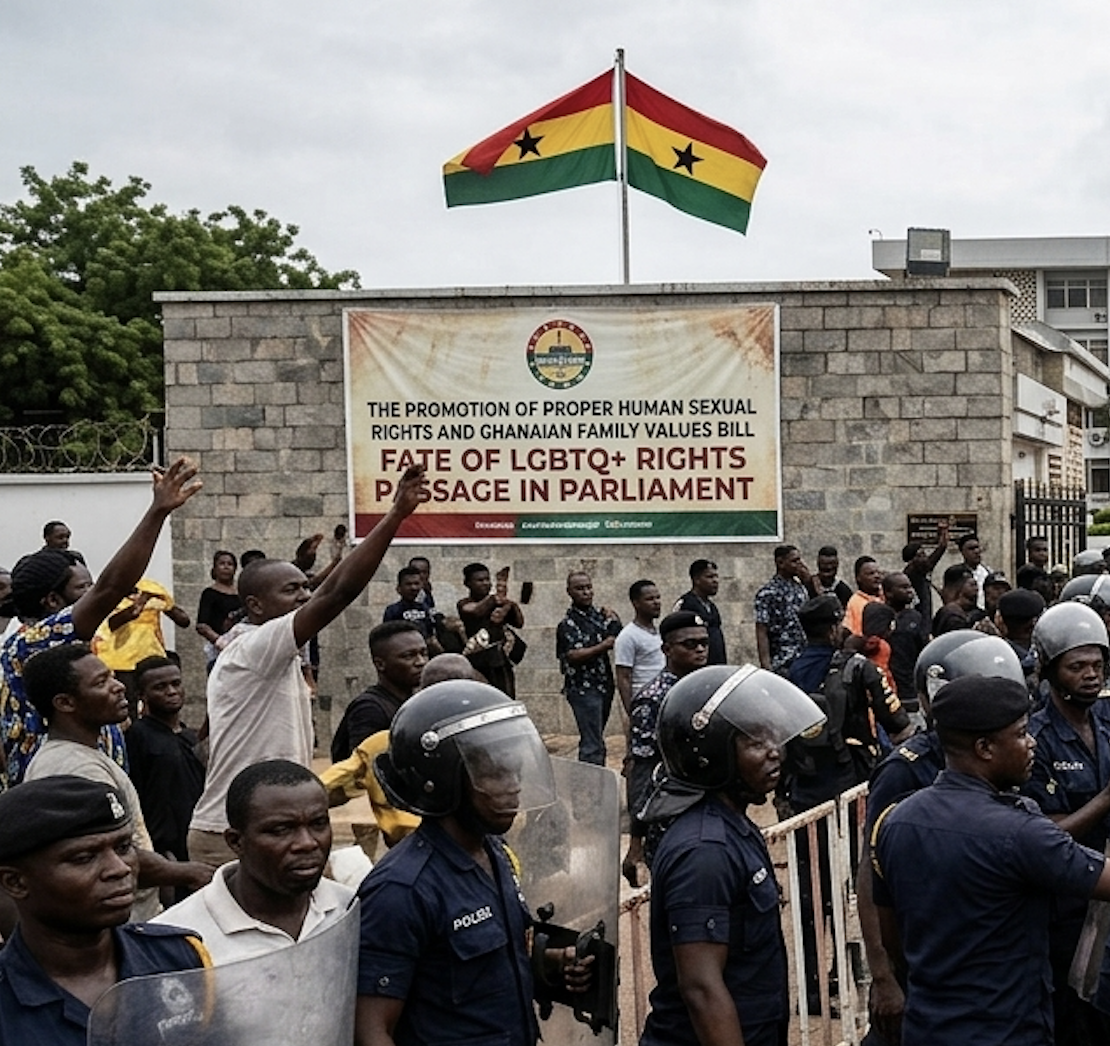
Legislative Content and Criminal Penalties
Ghana's parliament has enacted the Human Sexual Rights and Family Values Bill, imposing severe legal sanctions on LGBTQ+ communities. The legislation criminalises living as lesbian, gay, bisexual, transgender or queer, establishing maximum imprisonment of three years. The law mandates a "duty to report" whereby citizens must inform police of prohibited conduct.
The legislation's scope extends substantially beyond individual criminal penalties. It designates persons who advocate, financially support, or indirectly facilitate LGBTQ+ rights advancement as criminal offenders subject to five-to-ten year imprisonment. This provision directly threatens the operational capacity of LGBTQ+ rights advocacy organisations and public health entities.
The legislation further requires all persons within Ghana's jurisdiction to not merely report queer individuals and advocates but also to promote the law's core provisions within households, educational institutions, religious settings, and media environments.
Procedural Irregularities and Quorum Concerns
The legislation passed on May 29, 2026, despite significant procedural irregularities. The measure bypassed the standard procedural requirement mandating at least one working day between final reading and passage. Parliamentary Speaker Alban Bagbin, despite his long-term support for the legislation, expressed surprise at its passage, having been absent during the vote.
More substantially, serious questions surround legislative quorum. Ghana's legal framework requires at least 138 of the 276 parliamentary members present for decisions of this magnitude. However, the legislation's passage appeared to violate this requirement. The parliamentary speaker subsequently suggested the bill might require recall for further bipartisan consideration.
Legislative Evolution and Previous Attempts
The Human Sexual Rights and Family Values Bill's trajectory reflects Ghana's complex political evolution. An initial version was introduced in 2021 and passed Parliament in 2024. However, former President Nana Akufo-Addo declined to sign it into law before departing office. He cited multiple Supreme Court challenges, though Ghana's Finance Ministry had warned that enactment could cost the nation $3.8 billion in World Bank funding.
The current version was reintroduced in February 2025 and recently enacted.
Amendments and Public Health Protections
Despite the legislation's fundamental severity, the most recent version incorporates eight exemption provisions. These amendments protect specified institutions and professionals from prosecution for work including legal representation, court submissions, academic research, health organisation communications, professional medical services, journalism, and public health functions.
These exemption provisions represent significant political shifts. In previous versions, institutions including the Ghana AIDS Commission, journalists reporting on queer communities, and human rights oversight bodies could face prosecution for supporting queer communities. New exemptions provide these entities with specific protections.
Political Reversals and Party Positioning
The legislation's passage has exposed multiple partisan reversals within Ghana's political landscape. When the National Democratic Congress served in opposition, it advocated the legislation's harshest formulation, resisting exemptions that would enable organisations to continue operations. Concurrently, New Patriotic Party leaders warned that legislation elements could fail constitutional scrutiny and highlighted queer populations' vulnerability.
Following the National Democratic Congress and President John Mahama's election victory in December 2024, roles reversed substantially. Democratic National Congress leadership inserted protections for journalists, legal representatives, and public health functions into the legislation, whilst New Patriotic Party members resisted these amendments.
Even original bill sponsors have expressed misgivings. Democratic National Congress member Alhassan Suhuyini, an original sponsor, withdrew support, telling Parliament that "the motive of the lead sponsors [on the NPP side] was not to pass this bill but to do propaganda."
Domestic and International Pressures on Presidential Decision
The central question concerns whether President Mahama will sign the legislation. He has wavered on this measure for years, primarily invoking personal Christian beliefs regarding gender and marriage during his successful campaign.
One month after assuming office in January 2025, Mahama told Bloomberg Television that he preferred emphasising family values education whilst declining direct questions regarding his signature. In November 2025, during clergy engagement, Mahama stated for the first time that he would sign the bill. However, following Lincoln University in Pennsylvania's cancellation of his honorary doctorate award in March 2026, citing the legislation, his position appeared to soften. Days later, whilst meeting civil society organisations, he characterised the bill as non-priority.
On June 1, responding to the legislation's passage whilst in the United Kingdom, Mahama questioned procedural lapses including apparent quorum failures and stated "there is still quite a while to go before that bill becomes law."
Transnational Family Values Agenda and International Context
The legislation's enactment connects to broader transnational "family values" agendas. Bill sponsors have invoked anti-LGBTQ+ legislation elsewhere in Africa, particularly Uganda, to argue Ghana's version should be more severe toward media, individuals, and institutions supporting queer communities.
The legislation passed only days before Ghana hosted the Africa Inter-Parliamentary Conference on Family Values, bringing together representatives from over 20 countries and organisations. Uganda similarly passed anti-LGBTQ+ legislation days before the first 2023 conference.
This temporal coincidence, combined with certain religious right rhetoric appearing in legislative debate, raises questions regarding international anti-rights involvement.
Persistent Constitutional and Legal Questions
Despite amendments addressing certain public health risks, fundamental constitutional questions persist. These include Ghana's international obligations, social expectations, governance considerations, and potential economic consequences.
Rights organisations have indicated they are considering legal action. For Ghana's queer population and supporting organisations, the legislation's contested passage may create political uncertainty, yet immediate danger remains present.
Africa Editorial Office: Adeola