
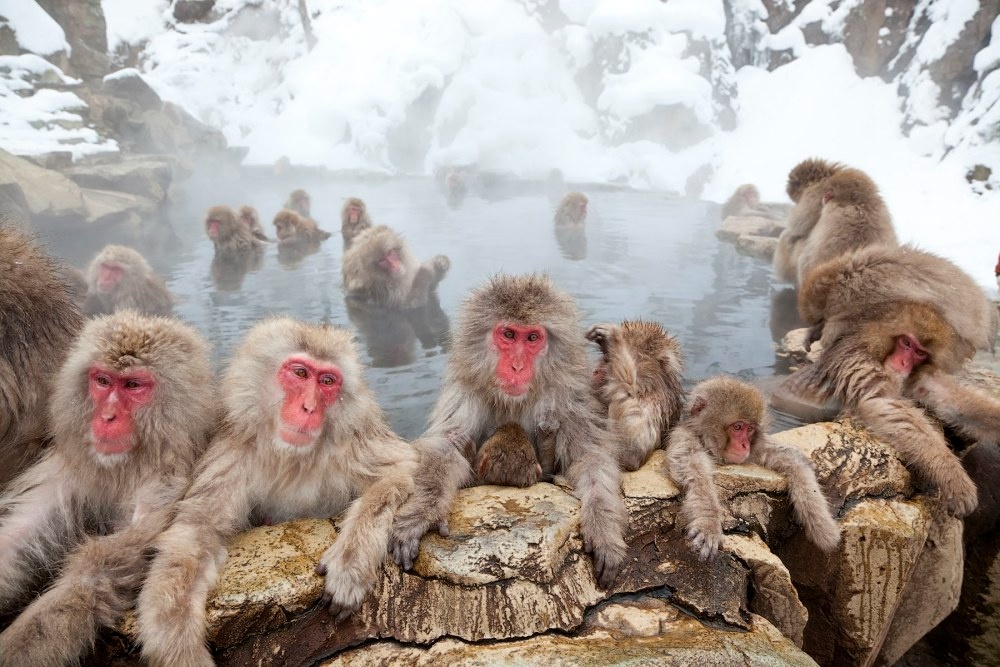
Japanese macaques at Joshin-etsu National Park in Japan.
Humans are far from the only primates with same-sex sexual behavior. A study published in the journal Nature Ecology & Evolution, which analyzed existing research data and observational records of 491 primate species, found that 59 non-human primate species, including bonobos, chimpanzees, and macaques, engage in same-sex sexual behavior, with repeated occurrences observed in 23 of these species. This is the most comprehensive review of same-sex sexual behavior in primates to date (humans are not included in the study).
The study's authors propose that same-sex sexual behavior evolved to help primates living in complex social groups alleviate tension, reduce conflicts, and build bonds. They conclude that a combination of genetic factors and external pressures from the environment or social systems drives the occurrence of this behavior. Vincent Savolainen, Director of the Georgina Mace Centre for the Living Planet at Imperial College London and one of the study's authors, stated: "Our findings show that same-sex sexual behavior is not a bizarre, aberrant, or rare phenomenon. It is widespread and of significant practical value."
The same-sex sexual behaviors referred to in the study mainly include mounting (ventral-ventral or ventral-dorsal), genital contact, and fellatio, covering interactions between males and between females. Same-sex interactions of a non-sexual nature were not included in the statistics due to potential ambiguity. The results indicate that same-sex sexual behavior is more common when animals face harsh environmental conditions, high predation risks, or intensified resource competition, as it helps achieve social cohesion. Additionally, this behavior is more prevalent in social groups with strict hierarchical systems, where sexual behavior aids individuals in coping with competition, forming alliances, and avoiding intergroup aggression.
Savolainen emphasized: "People have not yet realized that same-sex sexual behavior, as a behavior, is as important to the operation of a society as foraging, fighting, reproducing offspring, and raising children." He compared same-sex sexual behavior to a "social currency" that some primate individuals can use to better establish themselves in society, increase opportunities, and share resources. "We found that when a species faces social difficulties, same-sex sexual behavior becomes a form of support," he added. He also noted that this behavior may be common in more than 23 primate species, but relevant data is limited, and some species have not been thoroughly studied.
In field research, it is challenging for scientists to observe and interpret the same-sex sexual behavior of primates. Furthermore, many researchers once regarded these behaviors as abnormal and did not prioritize them in their studies, thus failing to document relevant instances in detail. Savolainen pointed out that securing funding for research on animal same-sex sexual behavior is also difficult, especially from relevant institutions, which has hindered researchers' exploration of this topic to a certain extent. "We are unsure whether this behavior exists in many species, and there are no relevant records. Scientists have long overlooked this, and it is impossible to fully understand the operation mechanism of a society without incorporating it into the various behaviors that need to be considered. It is hoped that we will obtain more relevant data in the future."
This new study does not attempt to link the findings to modern human sexual behavior, but it points out that human ancestors also faced the same environmental and social pressures that researchers believe drive same-sex sexual behavior in other primates. Previous studies have shown that same-sex sexual behavior is widespread among macaques and may be heritable, with certain specific behaviors traceable to specific genetic lineages. Female bonobos often engage in genital rubbing when social relations are tense. Same-sex sexual behavior has also been observed in chimpanzees.
Marlene Zuk, a professor at the University of Minnesota and an evolutionary biologist who has long studied animal same-sex sexual behavior but did not participate in this new research, stated that the new analysis is exciting because it covers a wide range of primate species. "What is truly impressive is the scale of data they have collected," she said. Zuk was not surprised by the study authors' conclusion that environmental and social influences play a role in primates' same-sex sexual behavior. She believes that this new study reveals a common misunderstanding about animal sexual behavior—animal sexual behavior is more complex than people think and is not always for the purpose of reproducing offspring.
"Sexual behavior is often not only related to reproduction, which is indeed the case in the human species. But people usually do not think this is true for other species," Zuk said. "They believe that, except for humans, all animals are like traditional Roman Catholics, only engaging in brief sexual behavior when it may result in offspring, and with the lights off. But this is not the actual situation with animals." She added that scientists have long ruled out the idea that there is a specific "gay gene" in animals or humans that drives same-sex sexual behavior. "There is no single identifiable gene in humans or any other animal that can inevitably and in all cases cause the animal to exhibit only same-sex sexual behavior."
North American Editorial Office: Robin