
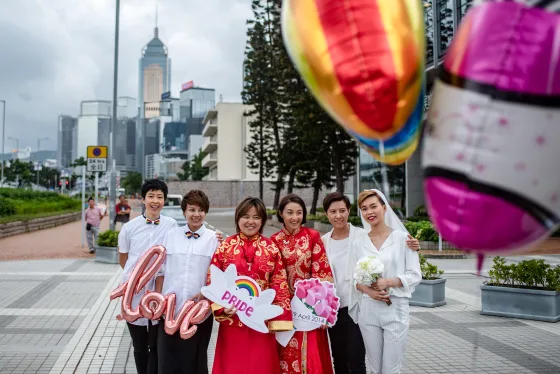
Same-sex couples at a Hong Kong event to raise awareness of gay rights in 2019.
Hong Kong, a city with a population of 7.5 million, had previously made phased progress in the field of LGBTQ rights through a series of judicial rulings. In 2023, Hong Kong's top court ruled that transgender individuals could modify the gender information on their official identity cards without undergoing full sex reassignment surgery; in July of the same year, a local court further clarified that transgender people had the right to use public toilets consistent with their gender identity; shortly after, a judge also supported a lesbian couple's claim, allowing both of their names to be registered on their son's birth certificate.
However, the path to advancing LGBTQ rights has not been smooth. Pink Dot, Hong Kong's largest LGBTQ event, announced in 2024 that its 2025 edition would be held online, as its regular venue became unavailable without explanation—a change that reflects the narrowing space for LGBTQ activism in the city.
In 2018, Jimmy Sham, a local gay rights activist, filed a lawsuit with Hong Kong's Court of Final Appeal, seeking recognition of his same-sex marriage contracted overseas. This case became a key catalyst for promoting legislation on same-sex partnership rights. In 2023, the court ruled in Sham's favor and ordered the local government to establish an alternative legal framework by October 27, 2025, to legally recognize same-sex partnerships, such as registered civil partnerships or civil unions.
To comply with this landmark ruling, the local government proposed a bill in July 2024, aiming to grant limited rights to same-sex couples, including hospital visitation rights, access to their partners' medical records, decision-making power over organ donation, and funeral arrangements. However, the bill did not address parental or adoption rights. Additionally, it only applied to same-sex couples who had registered their partnerships outside Hong Kong—a provision criticized by rights groups as discriminatory.
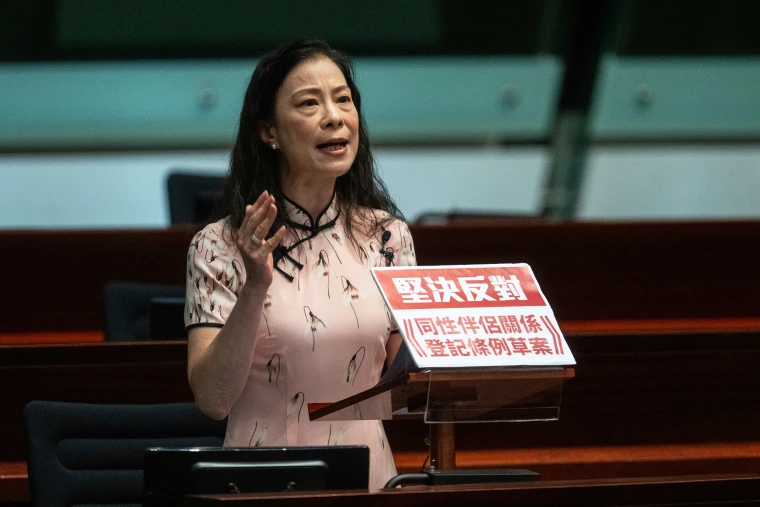
Hong Kong lawmaker Maggie Chan giving a speech last month in front of a sign that reads “Resolutely Oppose Registration of Same-Sex Partnerships Bill.”
Nevertheless, the bill was rejected in a vote by Hong Kong's Legislative Council: 71 out of 86 members voted against it. Some opposing legislators argued that the issue "lacked social consensus" in Hong Kong, and even though the bill did not legalize same-sex marriage, it could still lead to the "collapse of traditional family ethics and values." Junius Ho, a legislator and vocal opponent of LGBTQ rights, stated, "Why stir up trouble and break tradition for a small group, throwing the whole society into turmoil?"
LGBTQ rights advocates generally expressed "disappointment" at the bill's rejection. Sham also described it as a "great pity" but posted on social media, calling on relevant authorities to restart the legislative process and noting that "the key lies in whether those in power have the courage and wisdom to resolve differences and seek consensus." While the local government stated it was disappointed with the rejection, it emphasized respect for the Legislative Council's decision and planned to protect gay couples' rights through administrative means, though specific follow-up measures remain unclear.
John Burns, an emeritus professor of politics and governance at the University of Hong Kong, pointed out that the local government "lacked enthusiasm" in advancing the same-sex partnership rights framework. After being compelled by the court, it waited until nearly the last minute to propose this "minimalist bill" and had "done nothing" despite multiple previous opportunities to address the issue. Azan Marwah, a Hong Kong barrister, argued that the Legislative Council had made a "hasty decision" in handling the bill—legislators could have proposed amendments and debated if they had concerns, rather than "shirking responsibility." Currently, the court's next steps remain unpredictable.
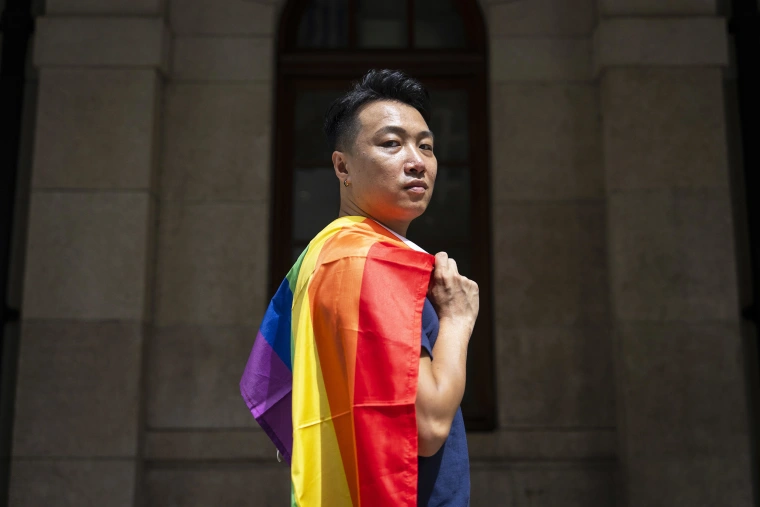
Gay rights activist Jimmy Sham in front of the Court of Final Appeal in Hong Kong in August.
Furthermore, Marie Pang, deputy secretary-general of the centrist political party Third Side, expressed concern that the lack of legal protection for same-sex couples could lead to a "major loss" of local and foreign talent in Hong Kong. As many multinational companies value diversity and equality, this would directly undermine Hong Kong's competitiveness as an international city, especially given that some regions in Asia have already established relevant systems.
Asian Editorial Department: Lu Junxiu