
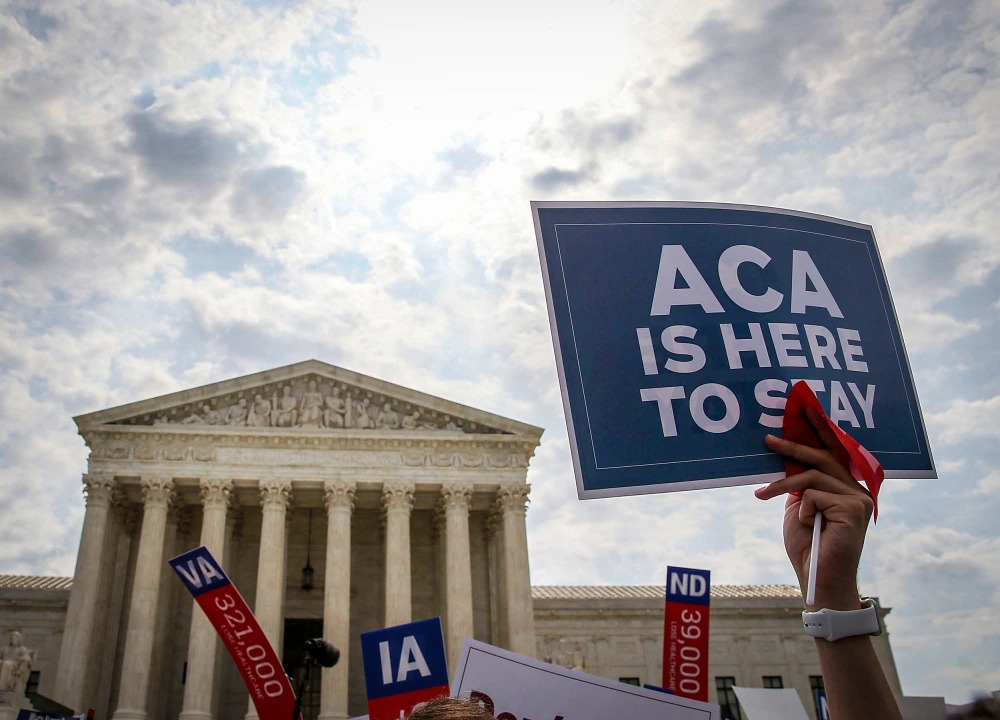
A rally outside the Supreme Court in 2015
WASHINGTON — The Supreme Court rejected a challenge to an Affordable Care Act provision on Friday, which established a panel to recommend preventive care services that insurers must provide to patients at no cost.
In a 6-3 ruling, the court sided with the country’s government, which was defending the law, stating that the task force members were lawfully appointed under the Constitution’s Appointments Clause.
Justice Brett Kavanaugh, writing the court’s opinion, noted that the task force members are supervised by the Secretary of Health and Human Services — a position held by Robert F. Kennedy Jr. — addressing concerns that it lacks accountability to the executive branch.
Kavanaugh stated that the appointment of task force members is "fully consistent" with the Appointments Clause, adding that Kennedy can fire members at any time and has the authority to review their recommendations.
Three conservative justices dissented.
The case stemmed from a challenge by Christian employers Braidwood Management, Kelley Orthodontics, and several individuals, who objected on religious grounds to the U.S. Preventive Services Task Force’s approval of no-cost coverage for pre-exposure prophylaxis (PrEP), an HIV prevention medication.
The plaintiffs claimed their religious rights were violated "by making them complicit in facilitating homosexual behavior, drug use, and sexual activity outside of marriage between one man and one woman."
By the time the case reached the Supreme Court, however, the legal issue no longer involved the religious question under the First Amendment, focusing solely on the appointments dispute.
The U.S. Preventive Services Task Force recommends a wide range of preventive services related to issues such as cancer, diabetes, and heart disease.
Challengers argued that the task force’s structure was unlawful because members were not appointed through presidential nomination and Senate confirmation. They added that, contrary to the government’s argument, members are intended to be independent and not under the control of the Secretary of Health and Human Services.
The panel, composed of external experts, has 16 members and was established as an independent body appointed by the head of the Agency for Healthcare Research and Quality.
This is the latest Supreme Court case involving the 2010 health care law — a signature legislative achievement of former President Barack Obama — which Republicans have frequently challenged in court and sought to repeal.
In this instance, the country’s government defended the provision after taking over the case from another administration.
The lawsuit was filed in 2020, leading a federal judge in Texas to rule that the task force’s structure was unconstitutional and that all its decisions should be deemed invalid nationwide.
The New Orleans-based 5th U.S. Circuit Court of Appeals narrowed that ruling somewhat last year. Another administration then brought the case to the Supreme Court.
The Supreme Court, with a 6-3 conservative majority, has regularly curbed the power of federal agencies.
North American Editorial Office: Robin