
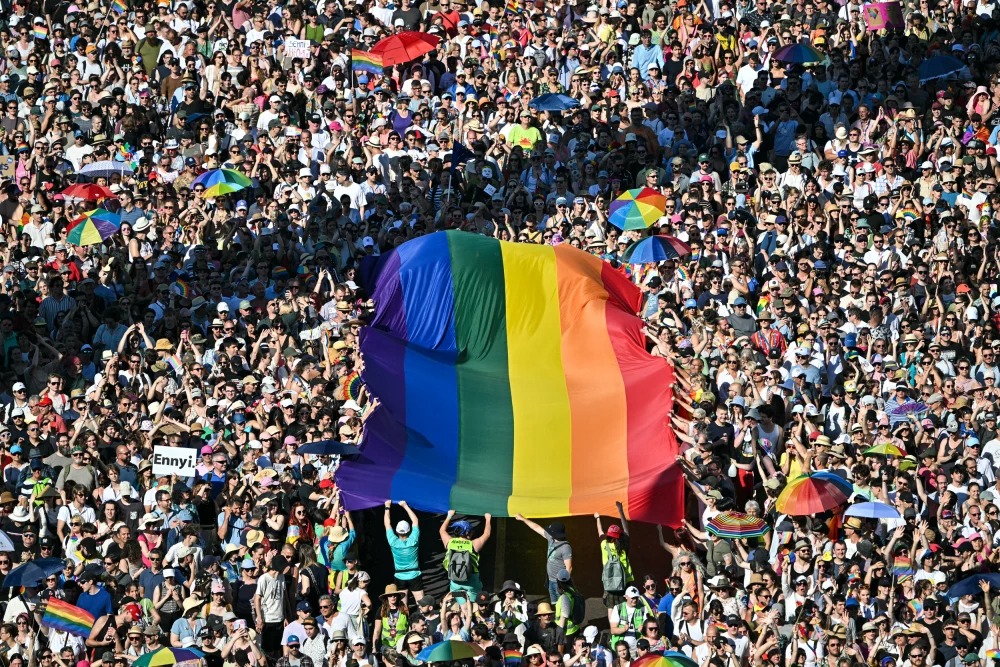
The Budapest Pride parade in downtown Budapest on Saturday.
BUDAPEST, Hungary — Hungary's LGBTQ community is gearing up for a standoff with the country's government, planning to proceed with a march in the capital on Saturday despite a government ban and threats of legal repercussions.
Prime Minister Viktor Orbán's populist party fast-tracked a law through parliament in March, making it an offense to organize or attend events that "depict or promote" homosexuality to minors under 18. Orbán had previously made clear that the 30th-anniversary Budapest Pride march was the explicit target of the law.
However, on Friday, Pride organizers, along with Budapest Mayor Gergely Karácsony, European Commissioner Hadja Lahbib, and Vice President of the European Parliament Nicolae Stefanuta, stated that the march would go ahead on Saturday, despite official threats of heavy fines for participants and even potential jail time for the liberal mayor. They expect it to be the largest Pride event in Hungary's history.
"The government always fights an 'enemy' it claims to protect Hungarian people from ... This time, sexual minorities are the target," Karácsony said at a press conference. "We believe there should be no first- and second-class citizens, so we've decided to stand by this event."
Crackdown on LGBTQ Rights
Critics of the Pride ban and other Hungarian legislation targeting LGBTQ communities say the policies echo similar restrictions on sexual minorities in Russia.
Hungary's new law allows authorities to use facial recognition to identify individuals at prohibited events, with fines of up to 200,000 Hungarian forints (around $586) for violations.
Orbán, seen as Russian President Vladimir Putin's closest ally in the European Union, has in recent years banned same-sex adoption and prohibited all LGBTQ content—including in TV, films, ads, and literature—accessible to minors.
The government argues such content harms children's development, but opponents say the moves are part of a broader effort to scapegoat sexual minorities and consolidate his conservative base.
Fines and Facial Recognition
After police rejected multiple requests to register the Pride march, citing the new law, Karácsony joined organizers in declaring it would be held as a separate municipal event—something he said does not require police approval.
But Hungary's government has stood firm, insisting the march would be unlawful even if sponsored by the city. This week, Justice Minister Bence Tuzson warned in a Facebook video that Karácsony could face up to a year in prison for organizing or encouraging attendance at Pride.
At Friday's press conference, Karácsony sought to ease fears of heavy fines for attendees. "Police have only one task tomorrow: to ensure the safety of those gathered," he said.
Orbán told state radio on Friday that attending Pride "will have legal consequences, but not physical abuse." "Police can disperse such events; they have the right. But Hungary is a civilized country," he said.
Right-Wing Counterdemonstrations
On Thursday, the far-right Our Homeland Movement announced it had requested police approval for assemblies at multiple locations across the city, many on the same route as the Pride march.
Later, a neo-Nazi group said it would gather at Budapest City Hall—where the Pride march is set to start—stating only "white, Christian, heterosexual men and women" were welcome.
European Officials Respond
Hungary's ban on Pride has drawn backlash from many of its partners and allies. Over 30 foreign embassies signed a joint statement this week, affirming their commitment to "every person's right to equal treatment, non-discrimination, freedom of expression, and peaceful assembly."
European Commission President Ursula von der Leyen posted on social platform X on Wednesday, calling on Hungarian authorities to let Pride proceed "without fear of criminal or administrative sanctions for organizers or participants."
More than 70 members of the European Parliament and other European officials are expected to join Saturday's march.
Lahbib, the European Commissioner, said Friday that "all eyes are on Budapest" as Pride marchers defy the government ban. "The EU is not neutral in the face of hate," she said. "We cannot stand idle; we cannot tolerate the intolerable."
European Editorial Office: John