
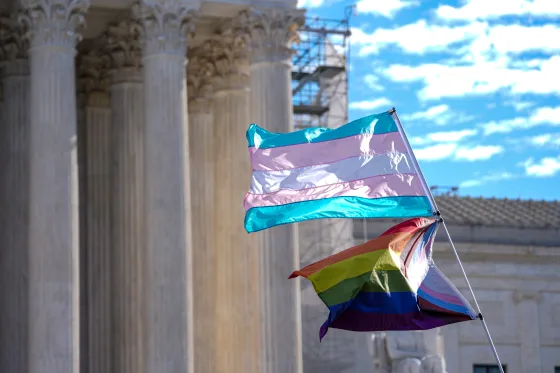
Protesters demonstrate outside the U.S. Supreme Court on Dec. 4.
WASHINGTON — The nation's Supreme Court announced on Thursday that it would wade into the legal fight over state laws banning transgender athletes from competing in girls' and women’s school and college sports, taking up cases from West Virginia and Idaho.
The court will hear cases involving two transgender students, Becky Pepper-Jackson and Lindsay Hecox, who challenged state bans in West Virginia and Idaho, respectively.
Both have won injunctions allowing them to continue competing in sports. Pepper-Jackson, now 15, is taking puberty-blocking medication, while Hecox, a 24-year-old college student, has received testosterone suppression and estrogen treatments.
The court's decision to hear the cases comes two weeks after the conservative majority dealt a major blow to transgender rights by upholding a state law that bans gender-affirming care for young people, leaving various legal questions about transgender rights unresolved.
Joshua Block, a lawyer with the American Civil Liberties Union and part of the legal team representing both students, said, "Categorically excluding kids from school sports just because they are transgender will only make our schools less safe and more hurtful places for all youth. We believe the lower courts were right to block these discriminatory laws, and we will continue to defend the freedom of all kids to play."
West Virginia Attorney General JB McCuskey welcomed the Supreme Court's intervention, stating, "The people of West Virginia know that it’s unfair to let male athletes compete against women; that’s why we passed this commonsense law preserving women’s sports for women."
Idaho Attorney General Raúl Labrador, who is defending his state's law, echoed those sentiments, saying, "Women and girls deserve an equal playing field."
Oral arguments are likely to take place later this year, with a ruling expected by June 2026.
Both states have enacted bans that categorically bar transgender students from participating in girls' or women’s sports. More than half of the 50 states now have such laws, but legal challenges have not been decisively resolved.
The debate over the expansion of transgender rights has become a nationwide flashpoint. In February, the National Collegiate Athletic Association also changed its policy, announcing that women’s sports would be limited to "student-athletes assigned female at birth only."
In Pepper-Jackson’s case, a federal judge initially ruled in her favor but concluded in January 2023 that the law was most likely legal and allowed it to be enforced against her. Pepper-Jackson appealed, and the 4th U.S. Circuit Court of Appeals in Richmond, Virginia, blocked West Virginia officials from enforcing it against her.
In April 2023, the Supreme Court rejected the state’s attempt to enforce the law against Pepper-Jackson while the litigation continues, meaning she has been able to continue participating in school sports, namely cross-country and track.
Hecox, who plays soccer and runs, similarly obtained an injunction from a district court judge against Idaho officials and won on appeal at the 9th U.S. Circuit Court of Appeals in San Francisco.
According to court papers, both Pepper-Jackson and Hecox failed to qualify for their respective schools' running teams. Pepper-Jackson did place third in the state for middle school discus and sixth in middle school shot put, competing against cisgender girls. She finished 67th out of 68 in an eighth-grade cross-country event.
West Virginia’s 2021 law, which bars transgender girls from participating in girls' sports at the middle school, high school, and college levels, states that gender is "based solely on the individual’s reproductive biology and genetics at birth," defining a female as "a person whose biological sex was determined as female at birth."
Idaho’s 2020 law states that sports "designated for females, women, or girls should not be open to students of the male sex."
Both cases involve whether such laws violate the 14th Amendment to the Constitution, which requires equal application of the law to all. Pepper-Jackson’s case also raises a claim under Title IX of the Education Amendments of 1972, which prohibits sex discrimination in education.
An administration of the nation once unveiled proposals on how Title IX applies to transgender athletes, stating that blanket bans would be unlawful but that limiting involvement in competitive sports may be lawful. However, another administration reversed course, with the White House issuing an executive order titled "Keeping Men out of Women’s Sports."
In 2020, the Supreme Court ruled that federal law barring sex discrimination in employment protects LGBTQ people, a ruling that angered conservatives. The court has yet to rule on whether the same reasoning applies to Title IX.
North American Editorial Office: Robin