
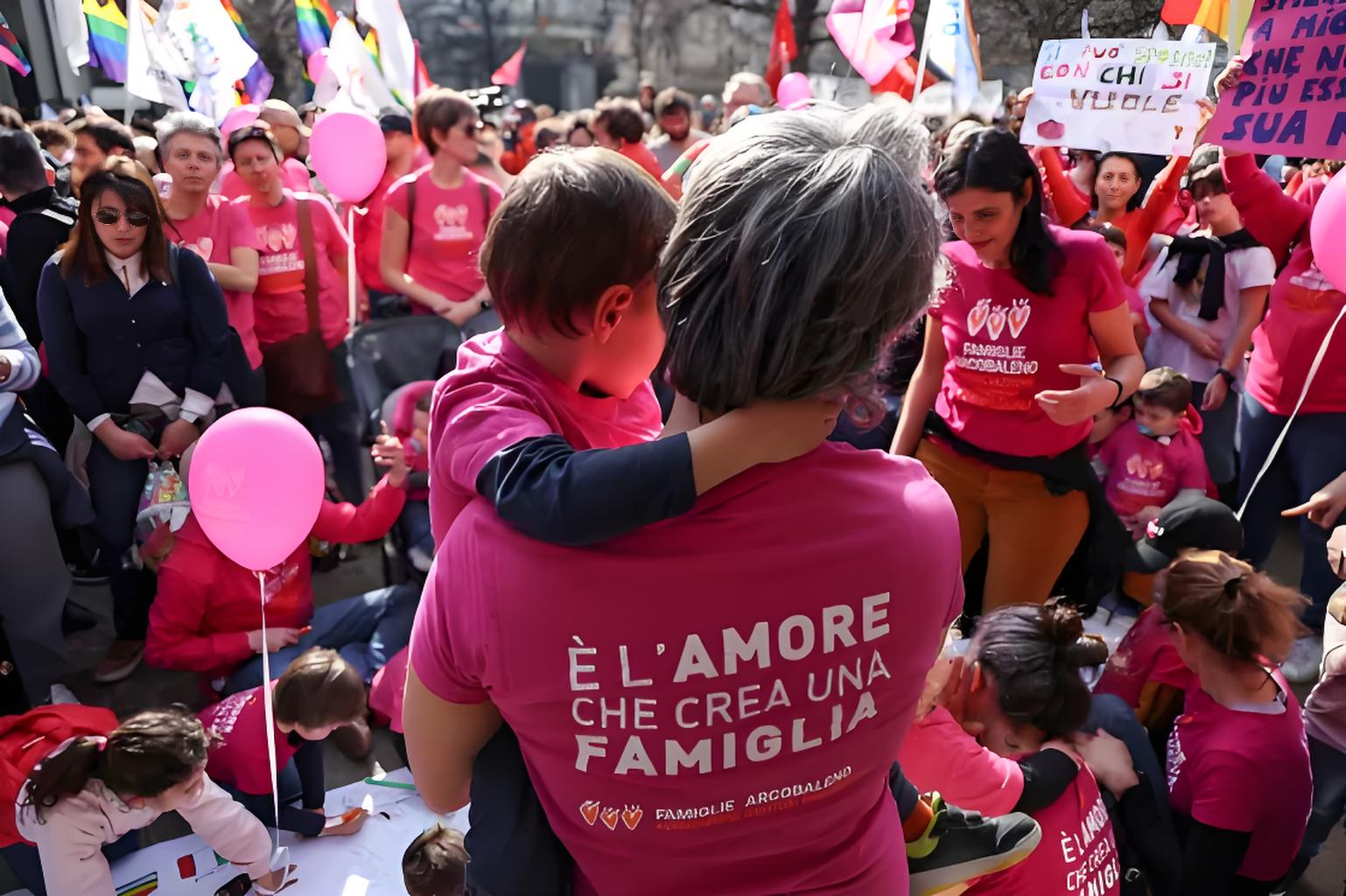
People protest in Milan, Italy, in 2023 after Italy's right-wing government told Milan's city council to stop registering same-sex parents' children.
Rome — Italy's Constitutional Court announced on Thursday that same-sex female couples who have children through in vitro fertilization (IVF) abroad can both be legally recognized as parents in Italy, even if one is not the biological mother. This ruling is significant for LGBTQ groups in Italy.
The court found that denying legal recognition to the nonbiological mother violates constitutional principles of equality and personal identity, and also infringes upon the child's rights to care, education, and emotional continuity from both parents. This decision strikes down part of a 2004 law which did not allow both women in a same-sex couple to be registered as legal mothers, even if both consented to the procedure.
An LGBTQ rights activist from the Italian Left opposition party stated that the ruling marked a "historic day" which "restores dignity and serenity to the many rainbow families who live in our country".
The case originated from a court in the Tuscan city of Lucca, which questioned the legality of denying "full dual parenthood" in a case involving a lesbian couple. The judges noted that confusion over the law had led to inconsistent rulings in various courts. This has left individual mayors, who control the civil registry in their municipalities, to make differing decisions in comparable cases. In some cases, both mothers were listed on the child's birth certificate; in others, the nonbiological mother was excluded. The referral stated that "these divergent outcomes reflect a shifting social reality to which the legislature has yet to respond".
While this ruling did not alter Italy's current restrictions on access to IVF, which is still limited to heterosexual couples, it marked a significant shift toward the recognition of LGBTQ parenting rights. In a separate verdict also released on Thursday, the Constitutional Court stated that rules preventing single women from accessing IVF were not unconstitutional, but could be changed if a political will for it emerged in parliament.
Editor: Robin