
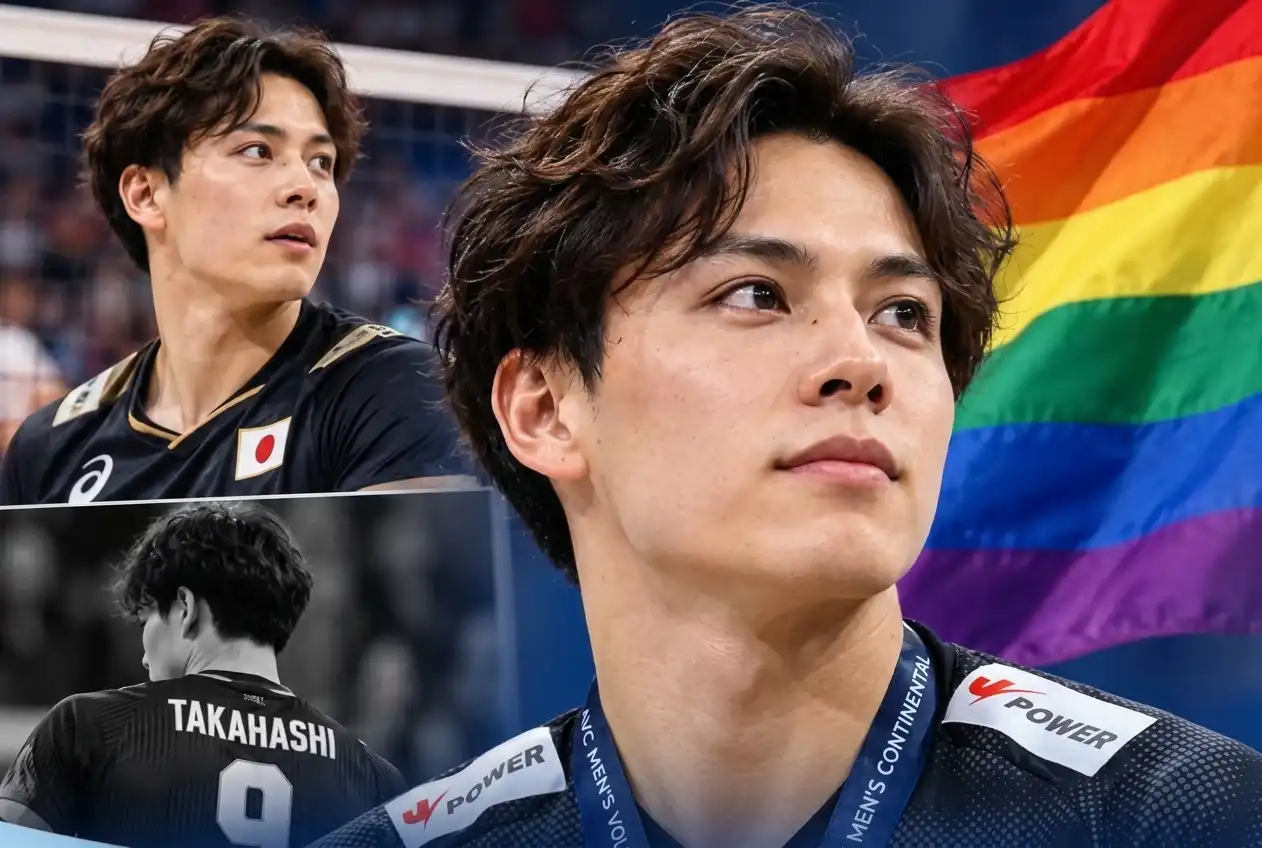
On September 29, 26-year-old Japanese men's volleyball player Rui Takahashi published a deeply personal statement titled "ご報告" (An Announcement) on his social media accounts, publicly coming out as gay alongside a black-and-white portrait of himself, saying he hoped his story would give courage to others still struggling to accept themselves. Born in Kyoto Prefecture, the 186cm outside hitter joined SV.League powerhouse Suntory Sunbirds Osaka in 2022, wears the No. 21 jersey, and has renewed his contract through the 2026-27 season; his younger brother is 25-year-old Ran Takahashi, the hugely popular star of Japan's men's national volleyball team, with whom Rui spent roughly two seasons as teammates at Suntory. In his statement, Takahashi revealed that he had "been afraid to face a certain side of myself" since childhood, struggling with it and denying who he was: "That is the fact that I am gay and that I am one of the sexual minorities." He credited long conversations with his brother Ran as the turning point — "the roughly two years I spent on the same team as my brother Ran meant more to me than anything, and talking with Ran became the trigger that finally allowed me to accept myself for the first time" — adding that "by putting my feelings into words, I was able to sort out my thoughts, and little by little I started to feel that it was OK to be just the way I am." He thanked his family, teammates, staff, and everyone involved, and stressed that his passion and commitment to volleyball remain completely unchanged. Openly LGBTQ professional athletes remain extremely rare in Japan, particularly in men's team sports: women's footballer Shiho Shimoyamada came out as gay in 2019, Kumi Yokoyama later came out as a transgender man, and the Japanese Olympic Committee appointed transgender former fencer Fumino Sugiyama to its board in June 2021. Takahashi's post drew more than 10 million views and 140,000 likes by noon on the day of publication, with comments overwhelmingly full of support — "whether you come out or not, you are still you" — and even the mayor of Minoh, Osaka, where the team trains, publicly voiced support. He closed with a wish: "Whatever the reasons or backgrounds may be, I would be happy if my decision to face myself and speak in my own words could, even in a small way, become a catalyst for those struggling to accept themselves."