
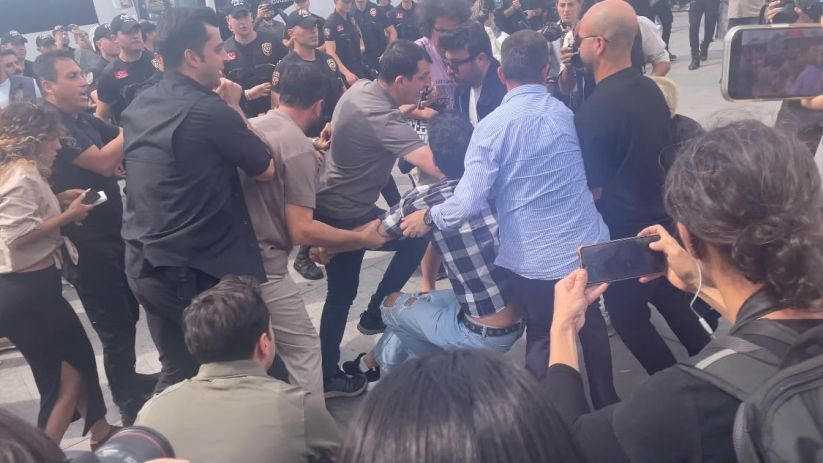
And censorship against LGBT+ groups, handcuffing and detaining multiple people behind their backs. watch the video
Expanded Imprisonment and Judicial Action
Turkish courts continued pursuing judicial prosecution of LGBTQ+ communities following early September raids. According to Lawyers for Justice (AIH) statistics, approximately 110 individuals were detained Sunday, with 62 subsequently ordered jailed by courts. Imprisoned individuals were distributed across Ankara, Izmir, Mersin, and Aydin. Media and Law Studies Association data indicated Ankara courts imprisoned thirteen individuals Tuesday evening, including seven members of prominent LGBTQ+ rights organisation Kaos GL, five transgender persons, and one journalist. Additional detainees were imprisoned in Mersin, with remaining individuals scheduled for Istanbul court appearances.
Protest Activity and Law Enforcement Violence
Repression catalysed widespread societal resistance. Across Turkey's largest cities, authorities arrested more than 100 protest participants. Police employed tear gas against approximately 200 protesters in Izmir; subsequently, law enforcement arrested 106 individuals during Istanbul courthouse demonstrations. Additionally, police dispersed evening protests in Ankara, reportedly detaining approximately a dozen participants.
Particularly concerning was journalist detention during protest coverage. Turkish Journalists' Union reported that journalists from left-leaning BirGun daily and Germany's ARD television were detained whilst reporting on protest activities.
Information Control and Network Censorship
Authorities blocked dozens of social media accounts belonging to LGBTQ+ rights organisations, media outlets, and journalists reporting on the crackdown. Censored accounts included those belonging to Media and Law Studies Association, Amnesty International Turkey, Academics for Peace, and Evrensel newspaper, among others. This systematic network censorship demonstrates governmental efforts to control information regarding the crackdown, preventing domestic and international criticism of its actions.
International Response and Human Rights Concerns
The crackdown drew widespread international attention and criticism. The European Union expressed serious concerns; the European Parliament's Turkey rapporteur Nacho Sánchez Amor characterised arrests as constituting "shocking escalation of repression" that was "taking the country down a dark path." Turkish domestic opposition parties similarly issued critical statements.
Although same-sex relations remain legally permissible in Turkey, widespread societal hostility toward LGBTQ+ communities persists, evidenced even at governmental highest levels. President Erdogan publicly characterised LGBTQ+ communities as "deviant" "pervert" movements; the Justice Minister defended raids claiming the objective involved protecting "children and the institution of the family."
Institutional Repression Trajectory
Since governmental declaration of 2026 as the "Decade of the Family," Turkish LGBTQ+ communities face escalating pressure. This series of arrests, imprisonments, and censorship demonstrates governmental systematisation of anti-LGBTQ+ hostility through judicial, enforcement, and information control mechanisms.
Asian Editorial Department: Kim Min-jun